Baum Professional Tree Care
Serves Cambridge, Kitchener, Waterloo, Fergus and Guelph and more
Fact-checking tree companies.
The three highest-scoring tree companies that serve Cambridge, ranked by LEAF Score. Every company in Ontario is checked the same way, on insurance coverage, arborist credentials, experience and reviews. No company can pay to be at the top of this page.
Serves Cambridge, Kitchener, Waterloo, Fergus and Guelph and more
Serves Cambridge, Kitchener, Puslinch, Waterloo and Guelph
Serves Cambridge, Burlington, Brantford and Hamilton
Ties are broken by number of credentials (each Certified Arborist, Board Certified Master Arborist and Tree Risk Assessment Qualification holder counts, so someone with two counts twice), then Google reviews. Beswick Tree Service and Capella Tree Service are tied at 5/10 leaves.
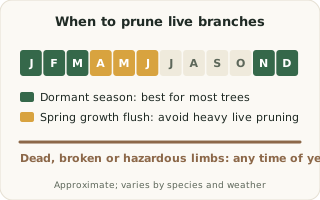
If the branches are dead or truly hazardous, then to protect your health and safety, it doesn't matter. Do it any time of the year. For live branches it is best done before the spring growth flush, when wounds close the fastest.
Anywhere in Cambridge, you need a City permit to remove a private tree 20 cm or wider, measured 1.4 m off the ground. The permit costs $64.98, and you must replace the tree or pay the City.
The Private Tree By-law (23-105) covers all private land, including house lots. You need a permit to remove a tree 20 cm (8 in) or wider, measured 1.4 m off the ground.
Each removal needs 1 to 4 replacement trees, depending on size. If you can't plant them, you pay $607 + HST per tree (2026 rate).
Only the City may prune or remove trees on City land (By-law 71-06). Call Service Cambridge about a city tree, including after-hours emergencies.
The Region of Waterloo Woodland Conservation By-law needs a permit before cutting in woodlands of 1 hectare (2.5 acres) or more.
A tree whose trunk sits on the line belongs to both neighbours. Ontario’s Forestry Act says you need your neighbour’s consent before removing or injuring it.
Ask the municipality before any work starts. A good tree company will also check for you and tell you who applies for the permit.
Service Cambridge
519-623-1340Official information page →Summary checked September 2026. It’s a plain-language guide, not legal advice. Bylaws change, so confirm with the municipality before you remove a tree.
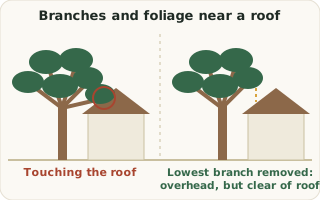
Evergreens typically grow more slowly, so they don't need as much clearance. Most deciduous trees should be pruned back approximately 2 metres (6 to 7 feet) from the house.
We caution against clearing too much from the house side. It can injure the tree and pose a greater risk to your house. For example, if a high branch breaks, there is no lower branch for it to get caught on.
Tree work is dangerous, and it’s expensive to fix when it goes wrong. Six questions worth asking any company, including the ones on this page.
Tree work is one of the most dangerous jobs out there. We do our best on our end, but these certificates can change before we have a chance to update them. Some good companies will give them to you without you even having to ask. Bonus!
You may get a Certified Arborist as your salesperson, but will the same be true of the person who works on your property? You won't know until you ask. A Certified Arborist may cost more, but it can cost a lot more if the work is done wrong and the tree dies early or your property is damaged.
It should say exactly which trees, and whether cleanup, wood removal, stump grinding and so on are included. The more detailed the quote, the better.
If a bylaw applies, agree up front who applies for the permit and who pays the fee. Removing a protected tree without one usually means a fine for the property owner, not the tree company.
See if the work can be scheduled in a slower season for a lower price. Clear obstacles (fences, gates, lawn ornaments, plants) before the crew arrives. Find someone online, such as on Facebook Marketplace, who will take the wood for free. Or change the scope of work, for example pruning only the lower half of the tree instead of the whole tree.
If branches touch or come close to a hydro line, call your local hydro utility (the one on your electricity bill) first. Only crews the utility approves can work near power lines.
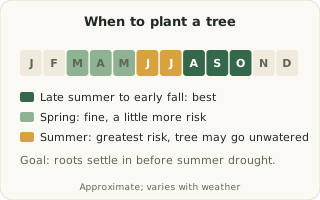
The goal is usually to give the tree as much time to establish as possible before summer drought. Therefore, late summer to early fall is the best time of year. Spring is acceptable as well; it just carries a little more risk. Summer planting is the greatest risk to the tree, in part because many Ontarians vacation and the tree may not get watered while they are away.
LEAF Scores reflect public records and research on the date checked. Always confirm insurance, certification and WSIB coverage directly with a company before you hire it.